 Add to Chrome
 Add to Firefox
 Add to Edge
D-VLA: A High-Concurrency Distributed Asynchronous Reinforcement Learning Framework for Vision-Language-Action Models
May 14, 2026
The rapid evolution of Embodied AI has enabled Vision-Language-Action (VLA) models to excel in multimodal perception and task execution. However, applying Reinforcement Learning (RL) to these massive models in large-scale distributed environments faces severe systemic bottlenecks, primarily due to the resource conflict between high-fidelity physical simulation and the intensive VRAM/bandwidth demands of deep learning. This conflict often leaves overall throughput constrained by execution-phase inefficiencies. To address these challenges, we propose D-VLA, a high-concurrency, low-latency distributed RL framework for large-scale embodied foundation models. D-VLA introduces "Plane Decoupling," physically isolating high-frequency training data from low-frequency weight control to eliminate interference between simulation and optimization. We further design a four-thread asynchronous "Swimlane" pipeline, enabling full parallel overlap of sampling, inference, gradient computation, and parameter distribution. Additionally, a dual-pool VRAM management model and topology-aware replication resolve memory fragmentation and optimize communication efficiency. Experiments on benchmarks like LIBERO show that D-VLA significantly outperforms mainstream RL frameworks in throughput and sampling efficiency for billion-parameter VLA models. In trillion-parameter scalability tests, our framework maintains exceptional stability and linear speedup, providing a robust system for high-performance general-purpose embodied agents.

Missing Old Logits in Asynchronous Agentic RL: Semantic Mismatch and Repair Methods for Off-Policy Correction
May 12, 2026Asynchronous reinforcement learning improves rollout throughput for large language model agents by decoupling sample generation from policy optimization, but it also introduces a critical failure mode for PPO-style off-policy correction. In heterogeneous training systems, the total importance ratio should ideally be decomposed into two semantically distinct factors: a \emph{training--inference discrepancy term} that aligns inference-side and training-side distributions at the same behavior-policy version, and a \emph{policy-staleness term} that constrains the update from the historical policy to the current policy. We show that practical asynchronous pipelines with delayed updates and partial rollouts often lose the required historical training-side logits, or old logits. This missing-old-logit problem entangles discrepancy repair with staleness correction, breaks the intended semantics of decoupled correction, and makes clipping and masking thresholds interact undesirably. To address this issue, we study both exact and approximate correction routes. We propose three exact old-logit acquisition strategies: snapshot-based version tracking, a dedicated old-logit model, and synchronization via partial rollout interruption, and compare their system trade-offs. From the perspective of approximate correction, we focus on preserving the benefits of decoupled correction through a more appropriate approximate policy when exact old logits cannot be recovered at low cost, without incurring extra system overhead. Following this analysis, we adopt a revised PPO-EWMA method, which achieves significant gains in both training speed and optimization performance. Code at https://github.com/millioniron/ROLL.
Thousand-GPU Large-Scale Training and Optimization Recipe for AI-Native Cloud Embodied Intelligence Infrastructure
Mar 11, 2026Embodied intelligence is a key step towards Artificial General Intelligence (AGI), yet its development faces multiple challenges including data, frameworks, infrastructure, and evaluation systems. To address these issues, we have, for the first time in the industry, launched a cloud-based, thousand-GPU distributed training platform for embodied intelligence, built upon the widely adopted LeRobot framework, and have systematically overcome bottlenecks across the entire pipeline. At the data layer, we have restructured the data pipeline to optimize the flow of embodied training data. In terms of training, for the GR00T-N1.5 model, utilizing thousand-GPU clusters and data at the scale of hundreds of millions, the single-round training time has been reduced from 15 hours to just 22 minutes, achieving a 40-fold speedup. At the model layer, by combining variable-length FlashAttention and Data Packing, we have moved from sample redundancy to sequence integration, resulting in a 188% speed increase; π-0.5 attention optimization has accelerated training by 165%; and FP8 quantization has delivered a 140% speedup. On the infrastructure side, relying on high-performance storage, a 3.2T RDMA network, and a Ray-driven elastic AI data lake, we have achieved deep synergy among data, storage, communication, and computation. We have also built an end-to-end evaluation system, creating a closed loop from training to simulation to assessment. This framework has already been fully validated on thousand-GPU clusters, laying a crucial technical foundation for the development and application of next-generation autonomous intelligent robots, and is expected to accelerate the arrival of the era of human-machine integration.
3ViewSense: Spatial and Mental Perspective Reasoning from Orthographic Views in Vision-Language Models
Mar 08, 2026Current Large Language Models have achieved Olympiad-level logic, yet Vision-Language Models paradoxically falter on elementary spatial tasks like block counting. This capability mismatch reveals a critical ``spatial intelligence gap,'' where models fail to construct coherent 3D mental representations from 2D observations. We uncover this gap via diagnostic analyses showing the bottleneck is a missing view-consistent spatial interface rather than insufficient visual features or weak reasoning. To bridge this, we introduce \textbf{3ViewSense}, a framework that grounds spatial reasoning in Orthographic Views. Drawing on engineering cognition, we propose a ``Simulate-and-Reason'' mechanism that decomposes complex scenes into canonical orthographic projections to resolve geometric ambiguities. By aligning egocentric perceptions with these allocentric references, our method facilitates explicit mental rotation and reconstruction. Empirical results on spatial reasoning benchmarks demonstrate that our method significantly outperforms existing baselines, with consistent gains on occlusion-heavy counting and view-consistent spatial reasoning. The framework also improves the stability and consistency of spatial descriptions, offering a scalable path toward stronger spatial intelligence in multimodal systems.
ATA: Bridging Implicit Reasoning with Attention-Guided and Action-Guided Inference for Vision-Language Action Models
Mar 02, 2026Vision-Language-Action (VLA) models rely on current observations, including images, language instructions, and robot states, to predict actions and complete tasks. While accurate visual perception is crucial for precise action prediction and execution, recent work has attempted to further improve performance by introducing explicit reasoning during inference. However, such approaches face significant limitations. They often depend on data-intensive resources such as Chain-of-Thought (CoT) style annotations to decompose tasks into step-by-step reasoning, and in many cases require additional visual grounding annotations (e.g., bounding boxes or masks) to highlight relevant image regions. Moreover, they involve time-consuming dataset construction, labeling, and retraining, which ultimately results in longer inference sequences and reduced efficiency. To address these challenges, we propose ATA, a novel training-free framework that introduces implicit reasoning into VLA inference through complementary attention-guided and action-guided strategies. Unlike CoT or explicit visual-grounding methods, ATA formulates reasoning implicitly by integrating attention maps with an action-based region of interest (RoI), thereby adaptively refining visual inputs without requiring extra training or annotations. ATA is a plug-and-play implicit reasoning approach for VLA models, lightweight yet effective. Extensive experiments show that it consistently improves task success and robustness while preserving, and even enhancing, inference efficiency.
RL-VLA$^3$: Reinforcement Learning VLA Accelerating via Full Asynchronism
Feb 05, 2026In recent years, Vision-Language-Action (VLA) models have emerged as a crucial pathway towards general embodied intelligence, yet their training efficiency has become a key bottleneck. Although existing reinforcement learning (RL)-based training frameworks like RLinf can enhance model generalization, they still rely on synchronous execution, leading to severe resource underutilization and throughput limitations during environment interaction, policy generation (rollout), and model update phases (actor). To overcome this challenge, this paper, for the first time, proposes and implements a fully-asynchronous policy training framework encompassing the entire pipeline from environment interaction, rollout generation, to actor policy updates. Systematically drawing inspiration from asynchronous optimization ideas in large model RL, our framework designs a multi-level decoupled architecture. This includes asynchronous parallelization of environment interaction and trajectory collection, streaming execution for policy generation, and decoupled scheduling for training updates. We validated the effectiveness of our method across diverse VLA models and environments. On the LIBERO benchmark, the framework achieves throughput improvements of up to 59.25\% compared to existing synchronous strategies. When deeply optimizing separation strategies, throughput can be increased by as much as 126.67\%. We verified the effectiveness of each asynchronous component via ablation studies. Scaling law validation across 8 to 256 GPUs demonstrates our method's excellent scalability under most conditions.
ERNIE 5.0 Technical Report
Feb 04, 2026In this report, we introduce ERNIE 5.0, a natively autoregressive foundation model desinged for unified multimodal understanding and generation across text, image, video, and audio. All modalities are trained from scratch under a unified next-group-of-tokens prediction objective, based on an ultra-sparse mixture-of-experts (MoE) architecture with modality-agnostic expert routing. To address practical challenges in large-scale deployment under diverse resource constraints, ERNIE 5.0 adopts a novel elastic training paradigm. Within a single pre-training run, the model learns a family of sub-models with varying depths, expert capacities, and routing sparsity, enabling flexible trade-offs among performance, model size, and inference latency in memory- or time-constrained scenarios. Moreover, we systematically address the challenges of scaling reinforcement learning to unified foundation models, thereby guaranteeing efficient and stable post-training under ultra-sparse MoE architectures and diverse multimodal settings. Extensive experiments demonstrate that ERNIE 5.0 achieves strong and balanced performance across multiple modalities. To the best of our knowledge, among publicly disclosed models, ERNIE 5.0 represents the first production-scale realization of a trillion-parameter unified autoregressive model that supports both multimodal understanding and generation. To facilitate further research, we present detailed visualizations of modality-agnostic expert routing in the unified model, alongside comprehensive empirical analysis of elastic training, aiming to offer profound insights to the community.
A Data-Centric Approach to Generalizable Speech Deepfake Detection
Dec 24, 2025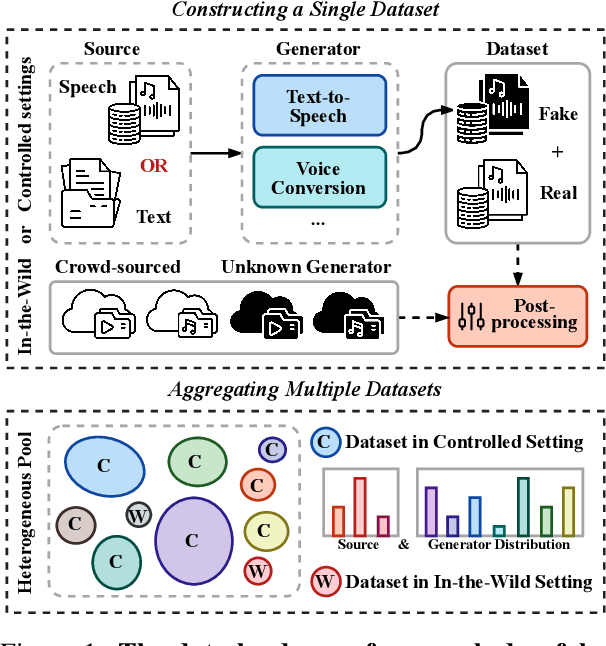
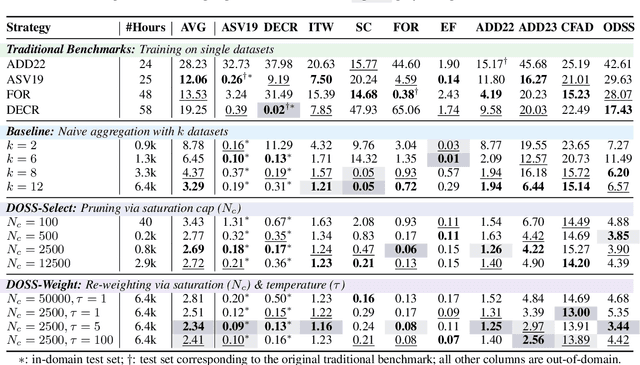
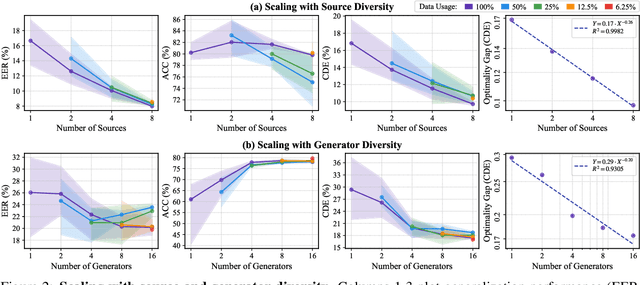
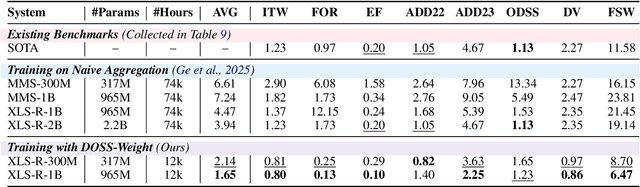
Achieving robust generalization in speech deepfake detection (SDD) remains a primary challenge, as models often fail to detect unseen forgery methods. While research has focused on model-centric and algorithm-centric solutions, the impact of data composition is often underexplored. This paper proposes a data-centric approach, analyzing the SDD data landscape from two practical perspectives: constructing a single dataset and aggregating multiple datasets. To address the first perspective, we conduct a large-scale empirical study to characterize the data scaling laws for SDD, quantifying the impact of source and generator diversity. To address the second, we propose the Diversity-Optimized Sampling Strategy (DOSS), a principled framework for mixing heterogeneous data with two implementations: DOSS-Select (pruning) and DOSS-Weight (re-weighting). Our experiments show that DOSS-Select outperforms the naive aggregation baseline while using only 3% of the total available data. Furthermore, our final model, trained on a 12k-hour curated data pool using the optimal DOSS-Weight strategy, achieves state-of-the-art performance, outperforming large-scale baselines with greater data and model efficiency on both public benchmarks and a new challenge set of various commercial APIs.
Improving Deepfake Detection with Reinforcement Learning-Based Adaptive Data Augmentation
Nov 10, 2025The generalization capability of deepfake detectors is critical for real-world use. Data augmentation via synthetic fake face generation effectively enhances generalization, yet current SoTA methods rely on fixed strategies-raising a key question: Is a single static augmentation sufficient, or does the diversity of forgery features demand dynamic approaches? We argue existing methods overlook the evolving complexity of real-world forgeries (e.g., facial warping, expression manipulation), which fixed policies cannot fully simulate. To address this, we propose CRDA (Curriculum Reinforcement-Learning Data Augmentation), a novel framework guiding detectors to progressively master multi-domain forgery features from simple to complex. CRDA synthesizes augmented samples via a configurable pool of forgery operations and dynamically generates adversarial samples tailored to the detector's current learning state. Central to our approach is integrating reinforcement learning (RL) and causal inference. An RL agent dynamically selects augmentation actions based on detector performance to efficiently explore the vast augmentation space, adapting to increasingly challenging forgeries. Simultaneously, the agent introduces action space variations to generate heterogeneous forgery patterns, guided by causal inference to mitigate spurious correlations-suppressing task-irrelevant biases and focusing on causally invariant features. This integration ensures robust generalization by decoupling synthetic augmentation patterns from the model's learned representations. Extensive experiments show our method significantly improves detector generalizability, outperforming SOTA methods across multiple cross-domain datasets.
From Sharpness to Better Generalization for Speech Deepfake Detection
Jun 13, 2025Generalization remains a critical challenge in speech deepfake detection (SDD). While various approaches aim to improve robustness, generalization is typically assessed through performance metrics like equal error rate without a theoretical framework to explain model performance. This work investigates sharpness as a theoretical proxy for generalization in SDD. We analyze how sharpness responds to domain shifts and find it increases in unseen conditions, indicating higher model sensitivity. Based on this, we apply Sharpness-Aware Minimization (SAM) to reduce sharpness explicitly, leading to better and more stable performance across diverse unseen test sets. Furthermore, correlation analysis confirms a statistically significant relationship between sharpness and generalization in most test settings. These findings suggest that sharpness can serve as a theoretical indicator for generalization in SDD and that sharpness-aware training offers a promising strategy for improving robustness.